Neutrl's synthetic dollar delivers premium market-neutral yields by harnessing exclusive OTC market strategies.
By setting new standards in stability and transparency, Neutrl brings the next evolution in crypto-native yields, making private strategies accessible for everyone.
Security
Risk-Minimized Architecture
Independent Verification
Core smart contracts and major upgrades are reviewed by independent security experts prior to deployment, with all updates undergoing external audits to uphold the highest security standards.
Onchain activity and integrations are continuously monitored using industry-leading advanced threat detection systems. Abnormal behavior is proactively identified and routed through clearly defined escalation paths to ensure rapid response and operational oversight.
Custody & Key Management
Custody and settlement conducted through institutional-grade custodians, with operational keys and sensitive actions governed by policy-based approvals, strict access controls, and comprehensive audit trails aligned with institutional best practices.
Protocol Controls
Risk controls are designed to limit impact through predefined caps, automated guardrails, and clearly scoped emergency actions, all of which are intentional, auditable, and subject to formal oversight.
Infrastructure Security
Security extends beyond code to operational practices. APIs, deployments, secrets, and access management are subject to regular reviews, independent assessments, and ongoing testing to ensure controls remain effective through industry-leading security researchers.
Security partners are disclosed for transparency. Coverage may vary by product and over time.
Our Products
Stable, Transferable, Yield-Generating
NUSD. Designed for Capital Efficiency.
NUSD is an institutional-grade, DeFi composable synthetic dollar backed by delta-neutral strategies and other crypto assets.
Deposit or swap supported stablecoins for NUSD to enter the Neutrl system.
Stay fully liquid while preparing to earn yield through staking.
2 | Stake
Stake NUSD to mint sNUSD and activate liquid yield.
Your balance begins accruing yield immediately while remaining withdrawable.
3 | Commit
Neutrl allocates capital across market-neutral strategies like OTC hedging and basis trades.
Returns accrue to sNUSD holders without directional market risk.
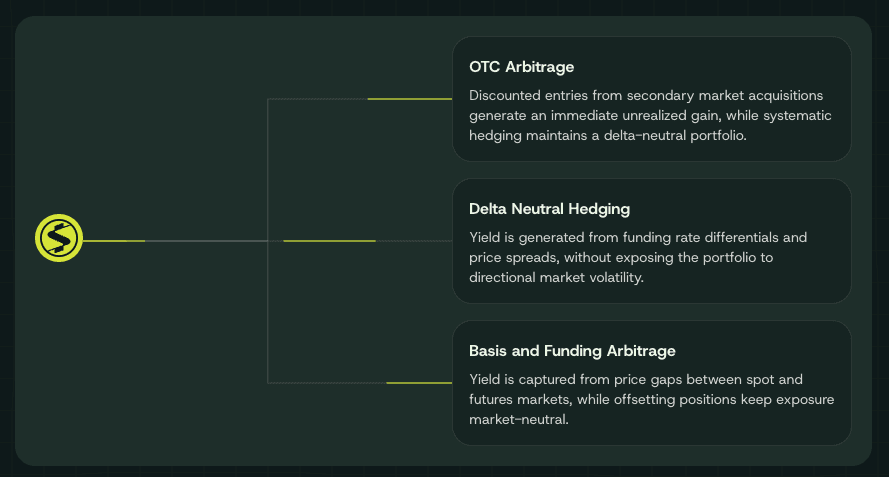
OTC Arbitrage
Discounted entries from secondary market acquisitions generate an immediate unrealized gain, while systematic hedging maintains a delta-neutral portfolio.
Delta Neutral Hedging
Yield is generated from funding rate differentials and price spreads, without exposing the portfolio to directional market volatility.
Basis and Funding Arbitrage
Yield is captured from price gaps between spot and futures markets, while offsetting positions keep exposure market-neutral.
sNUSD. High Yield, Fully Transferable.
sNUSD is the liquid staking version of NUSD, acting as a high yield bearing account. It remains fully transferable with a high degree of DeFi composability.
This protocol differs from other stablecoins, like Usual or Ethena, in that yield is derived primarily from OTC Locked Tokens, where the delta is fully hedged, and the remainder of the portfolio is deployed to Liquid Strategies to maintain sufficient liquidity buffer in times of capital stress.
NUSD maintains its peg through delta-neutral strategies, onchain transparency, and overcollateralization:
• Delta-Neutral Hedging: Derivatives and perpetual futures offset directional risk, keeping NUSD stable during market volatility.
• OTC Discounts: Discounted OTC asset purchases provide a safety margin, supporting the peg even in challenging conditions.
• Duration Matching: The protocol aligns asset and liability durations to ensure sufficient liquidity for redemptions.
• Liquid Reserves: Stablecoins (e.g., USDT, USDC, USDe) and liquid delta-neutral positions back NUSD, maintaining stability under stress.
NUSD is fully backed by a diversified portfolio of assets designed to provide security, transparency, and resilience.
Portfolio Composition - NUSD is backed by a mix of:
• OTC-acquired crypto assets: Purchased at significant discounts, providing a higher margin of safety.
• Stablecoins (e.g., USDT, USDC, USDe): Highly liquid and composable within DeFi and CeFi ecosystems.
• Delta-Neutral Positions: Liquid positions that generate yield while mitigating directional risk.
Transparency: All assets are confirmed using a combination of ZK-proofs, custodian attestations, and third party audits.
Risk Management Framework: The protocol employs a robust risk management framework that includes stress testing, margin monitoring, and proactive position adjustments to protect the backing assets and ensure their security.
If NUSD temporarily loses its peg, the protocol has several mechanisms in place to restore stability:
• Market Incentives: Arbitrage opportunities naturally arise when NUSD deviates from its peg, incentivizing traders and market makers to buy or sell NUSD and redeem against USDC 1:1 to bring its price back in line with its intended value.
• Delta Hedging Adjustments: The protocol adjusts its derivatives and perpetual futures positions to rebalance the collateral portfolio and stabilize NUSD's value.
• Reserve Deployment: Liquid reserves, including stablecoins and delta-neutral positions, can be rapidly deployed to support the peg and meet redemption demands.
• Proactive Adjustments to Backing: If market conditions are extreme, the protocol may temporarily scale down exposure to volatile assets or rebalance its portfolio to prioritize stability over yield. The combination of these measures ensures that NUSD can recover its peg efficiently, even during periods of high market volatility.
While the locked token strategy involves longer-term, illiquid investments, the protocol mitigates these risks through careful design, liquidity management, and diversification:
• OTC Discounts: Locked tokens are purchased at discounts, providing a safety margin even in adverse markets.
• Delta-Neutral Hedging: Market risk is reduced through hedging strategies, limiting exposure to price fluctuations.
• Diversified Portfolio: Locked tokens are balanced with liquid assets like stablecoins and delta-neutral positions, ensuring operational liquidity.
• Secondary Market Access: Partnerships with OTC brokers and secondary markets enable asset liquidation to generate additional liquidity.
Liquidity, OTC Exposure, and How Neutrl Generates Yield
article
Liquidity, OTC Exposure, and How Neutrl Generates Yield
February 27, 2026
Since launch, Neutrl has grown to approximately $230M in total value locked within four months while consistently distributing ~10% APY at scale. Growth has been accompanied by strong participation, with NUSD maintaining an ~81% staking ratio, meaning the majority of circulating supply is staked into sNUSD and actively earning. This level of staking participation reflects the current demand for real yield in a market where defi yields have collapsed from previous highs.
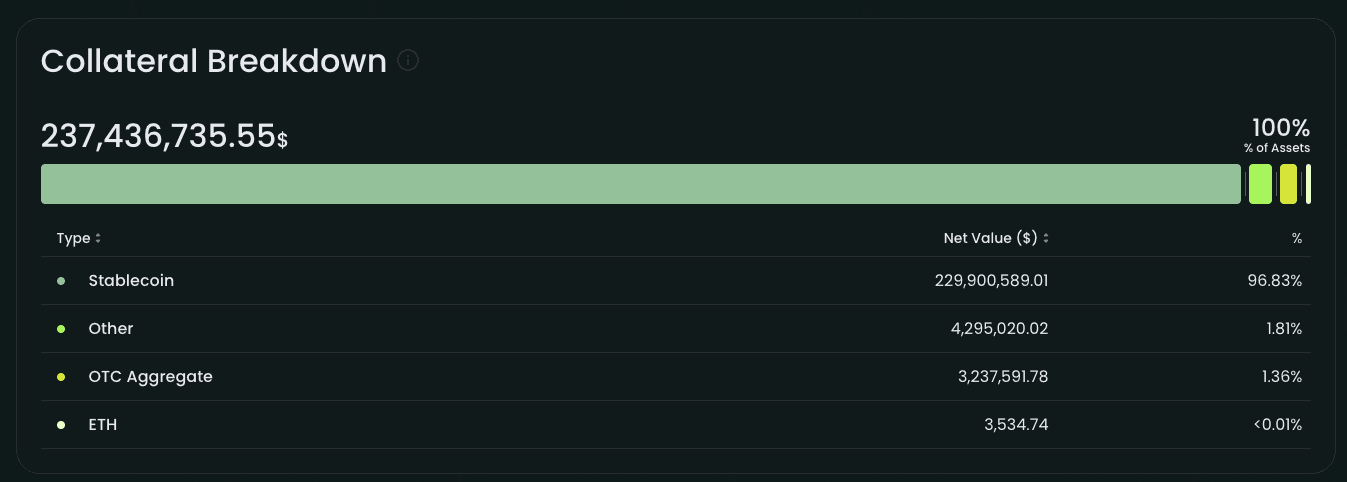
At the same time, a recurring question has emerged around the structure of the reserves. Specifically, how Neutrl is able to sustain that level of yield when the strategy remains largely liquid and the OTC allocation displayed on the transparency dashboard represents a relatively small percentage of reported NAV. Understanding this requires a closer look at how capital is deployed, how profits are realized, and how collateral is valued within the book.
What exactly is Neutrl?
Neutrl operates as a tokenized fund built around an overcollateralized synthetic dollar. NUSD is the liquid claim on the treasury, fully backed by underlying collateral and redeemable at all times. When users stake NUSD, they receive sNUSD, which represents a proportional, yield-bearing claim on the strategy portfolio. As the portfolio’s underlying strategies generate returns, that yield is allocated directly to sNUSD holders via the exchange rate, compounding over time.
The strategy engine centers on OTC arbitrage. Neutrl acquires tokens in secondary markets at negotiated discounts, creating an embedded unrealized gain at entry. These positions are immediately hedged using derivatives or institutional borrow so that exposure remains market-neutral. As vesting schedules progress and positions are unwound, profits are realized into USDT/USDC without relying on directional price movement. Each opportunity is evaluated based on counterparty quality, liquidity at unlock, hedge depth, and concentration limits before capital is deployed.
Complementing OTC arbitrage are delta-neutral funding and basis strategies. The portfolio captures yield from funding rate differentials and price spreads between spot and futures markets and between CEXs while maintaining offsetting positions to eliminate directional risk. Allocations across these components shift with market conditions, ensuring capital remains productive while preserving liquidity and maintaining a consistently market-neutral posture.
Understanding OTC deployment cycle
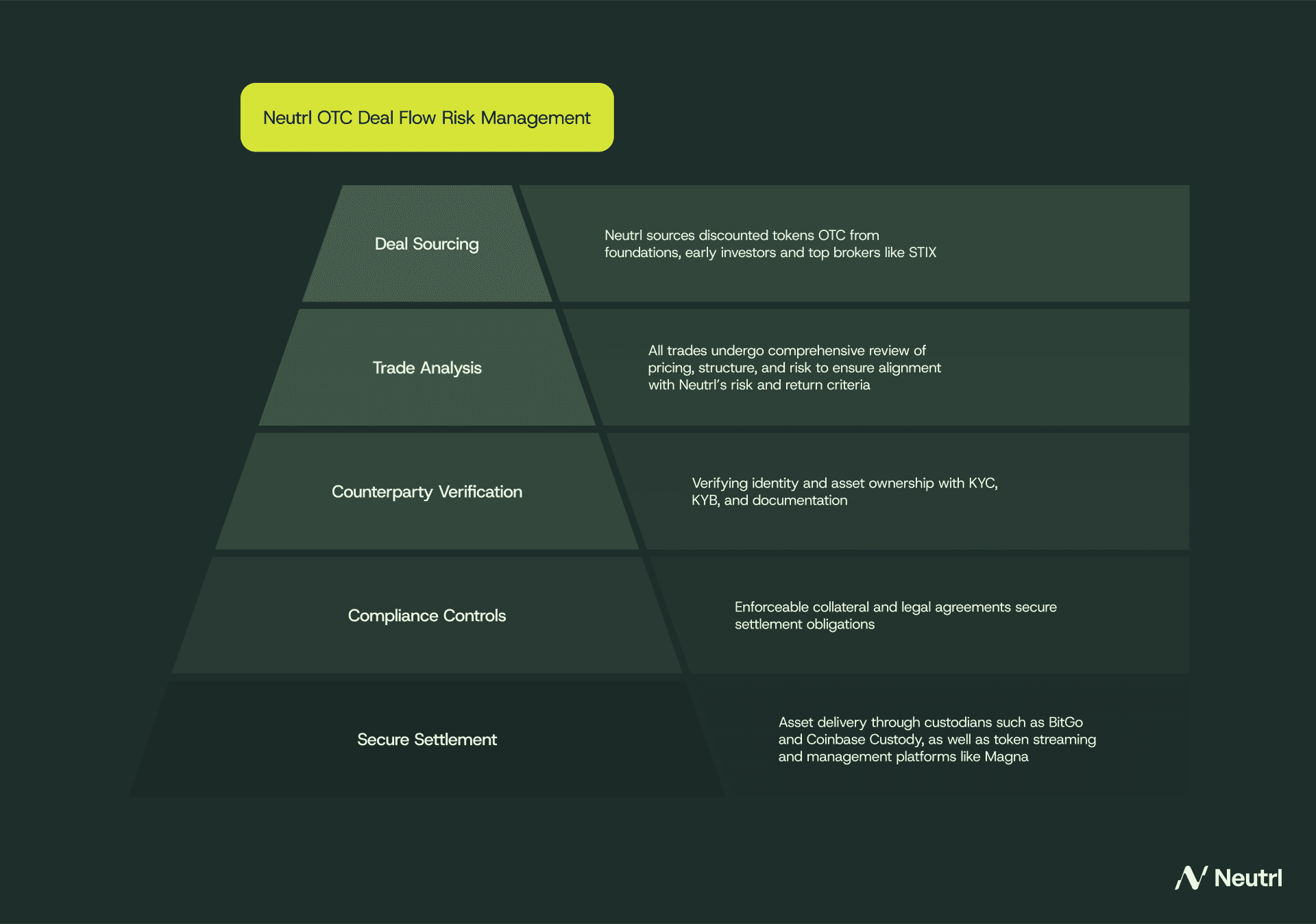
Each OTC opportunity is privately sourced and subjected to detailed analysis before capital is committed. This includes assessing counterparty credibility, legal and vesting structure, expected circulating supply at unlock, projected secondary liquidity, hedge availability and cost, funding stability, and overall portfolio concentration impact. Position sizing is determined within strict liquidity and duration parameters so that redemptions and treasury stability remain intact. Capital is deployed only once settlement terms are finalized, hedges are secured, and execution pathways are operational.
Neutrl values OTC positions using a conservative, liquidation-focused methodology designed to protect depositors and preserve solvency clarity. Locked tokens acquired at a discount are marked using time-weighted, illiquidity-adjusted valuations that reflect realistic exit prices today rather than forward-looking spot assumptions. Longer-dated tranches receive deeper discounts, and each vest is subject to a valuation cap to account for execution risk and liquidity constraints, including scenarios near unlock. These valuations are independently verified via zero-knowledge proofs through Accountable, which confirms hedge coverage and reserve integrity without exposing sensitive wallet details. See Neutrl’s transparency dashboard here.
Capital that is not actively deployed into live OTC positions continues to generate return. Undeployed funds are allocated to yield-bearing stable assets such as USDS and sUSDe, where they earn a base yield while remaining fully liquid. This approach keeps the treasury productive between OTC settlement cycles, with capital positioned to scale into new opportunities as they are finalized and executed.
Vesting, reserves, and ongoing yield distribution
Prior to public launch in November, Neutrl operated a private beta from May through November with roughly $50M in TVL. During that period, meaningful OTC exposure was deployed and excess PnL was generated. At public launch, OTC exposure represented closer to ~15% of the book. As TVL grew and those early tranches vested and were systematically unwound, unrealized gains converted into realized profits and accumulated in reserves, strengthening the treasury and supporting both distributions and future deployments.
The OTC allocation currently reflects roughly ~2% of the book because earlier tranches are continuing to vest and be realized while new deployments move through the execution pipeline. As each tranche vests, the embedded discount converges, positions are unwound in a hedged manner, and PnL is realized. That capital flows back into the treasury as liquid reserves. New OTC entries require negotiated settlement timelines, documentation, custody coordination, and hedge setup, so exposure builds progressively while remaining reflexive to opportunity quality and market conditions.
Today the treasury is predominantly liquid because capital remains reflexive rather than a fixed allocation target. OTC deal flow occurs in cycles, and settlement structures vary across counterparties. Between deployment windows and vesting cycles, capital is rotated into yield-bearing stable assets. This maintains a base yield floor while preserving flexibility to redeploy as new opportunities are finalized. The stablecoin aggregate shown on the transparency dashboard reflects this current posture.
Yield distribution is supported by multiple components of the book. On approximately $230M of collateral, a ~10% APY implies roughly $23M in annualized distribution capacity. A meaningful share of the treasury earns base yield through stable allocations, contributing toward that requirement. Realized profits from earlier OTC tranches further support distributions, and a portion of excess PnL generated during the Private Beta has been retained within reserves to strengthen distribution continuity during the growth phase.
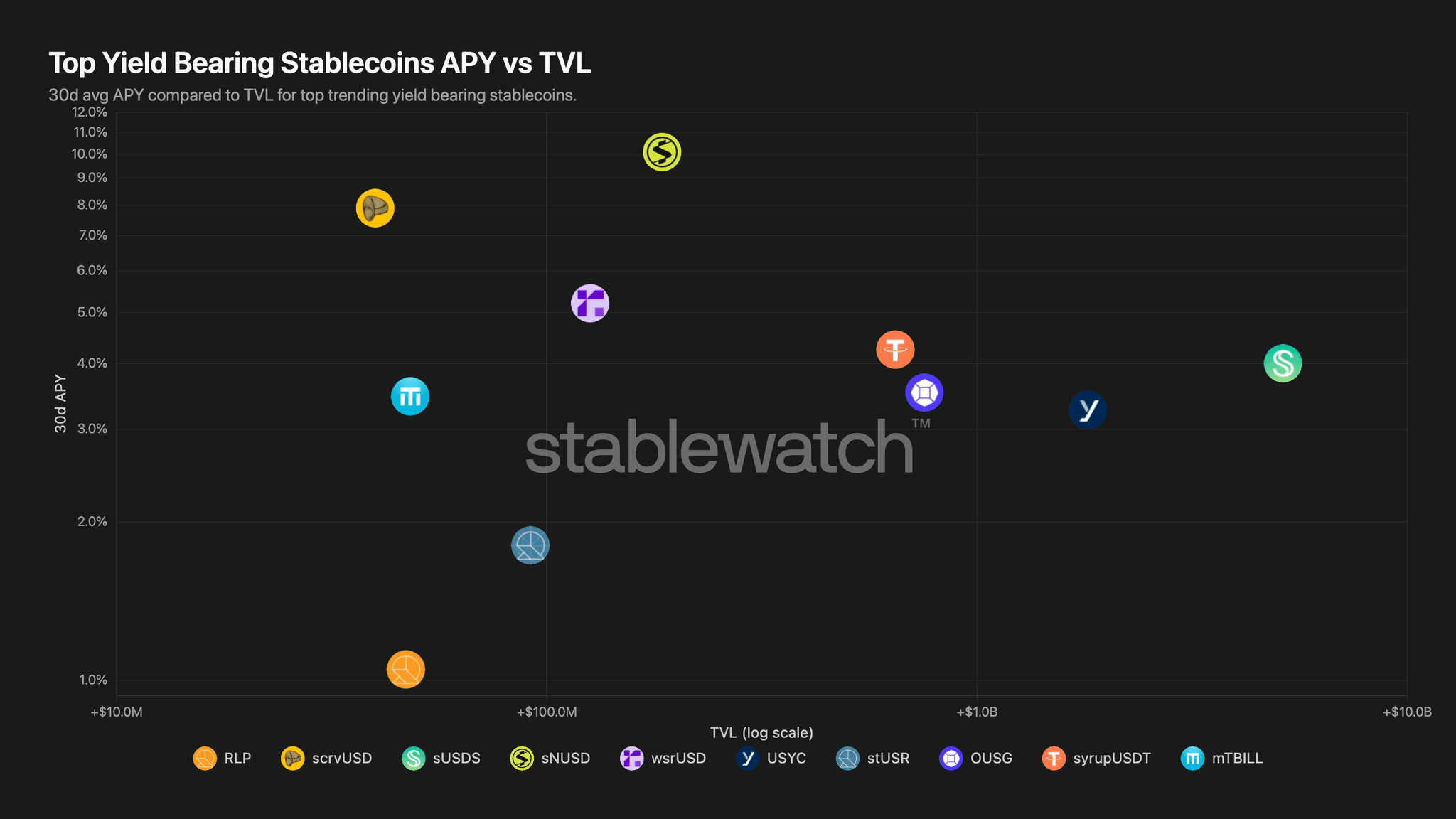
While the majority of the book is liquid, sNUSD is currently distributing the highest yields among synthetic dollars with more than $200M in TVL, reflecting realized performance and productive treasury allocation. At the current level of OTC deployment, yield may moderate as a larger share of capital remains in liquid stable allocations between deployment cycles. Several OTC transactions are actively moving through sourcing, negotiation, and settlement coordination, and exposure will increase as those deals are finalized. As new tranches go live and begin vesting, their contribution to overall yield will scale accordingly.
Looking forward
Neutrl is entering its next phase of growth, with new OTC tranches progressing through settlement and moving toward deployment. As these positions go live and begin contributing to the book, their impact on realized yield will increase. In parallel, new integrations are underway that position NUSD and sNUSD as core building blocks for additional yield products across defi, expanding distribution as the strategy engine scales alongside demand.
Looking ahead, Neutrl will continue expanding transparency around protocol reserves. In the coming weeks, we will introduce deeper visibility into the liquid portion of the book so partners and independent third parties can clearly see how capital is allocated between deployment cycles.